UK data protection law has changed under the Data (Use and Access) Act 2025 (DUAA),…
As the Conveyancing Association (CA) marks its 25th anniversary, its role in shaping the modern conveyancing process is perhaps most clearly seen through its policy and reform work. At the centre of that is Beth Rudolf, Director of Delivery, whose focus has been on turning industry frustration into practical, workable change.
Beth’s involvement with the CA began 12 years ago with a conversation with CA Co-Founder, Eddie Goldsmith, at an industry event. At the time, the focus was on a problem familiar across the profession: repeated additional enquiries that added delay without improving outcomes.
“There was a real frustration around the same issues coming up again and again,” she explains, “particularly around additional enquiries due to lack of expertise that didn’t move the transaction forward or issues causing Land Registry requisitions.”
That conversation led to the first iteration of the CA’s Technical Protocol, bringing conveyancers together to identify where unnecessary friction existed whether due to poor communication, failure to collect monies on account at the earliest opportunity, lack of pre-sale preparation or title concerns such as restrictive covenants, planning permission and building regulations. All symptoms of delay and frustration were examined in detail to identify the cause and potential solutions, with the aim of creating a more consistent and proportionate approach.
One of the clearest examples of this is the Leasehold Property Enquiries form, the LPE1. First developed in 2015 by the CA through collaboration with stakeholders across the sector, it created a standard set of enquiries designed to reduce duplication and inconsistency in leasehold transactions.
Making the form freely available was a deliberate decision, ensuring it could be adopted across the industry. The impact has been significant, reducing delays and providing greater clarity for conveyancers, lenders and managing agents.
The same approach led to the development of the FME1 for managed freeholds, anticipating the shift away from leasehold houses and the increasing use of estate rent charges and service charge arrangements on freehold properties.
By 2016, the Association had developed its White Paper on improving the home buying and selling process, drawing together conveyancers, estate agents, lenders, surveyors, valuers and brokers to examine why transactions were becoming slower and more complex.
This was not theoretical work. It was grounded in the day-to-day experience of conveyancers.
“The reason I became a freelance consultant was because, when I was a qualified practising conveyancer, I could do my job proactively,” Beth says, “but transactions would still fall through or clients would still be unhappy because of delays elsewhere in the chain.”
That perspective shaped the CA’s approach. Rather than focusing on isolated fixes, the aim was to understand the entire process and identify where change would have the greatest impact.
Alongside these practical tools, the CA has played a sustained role in policy development. Its work on leasehold reform, including engagement with Parliamentary groups and Select Committees, has focused on improving transparency, reducing complexity and addressing unnecessary cost within the system.
Beth is clear about how that engagement works in practice, and is careful about how it is described.
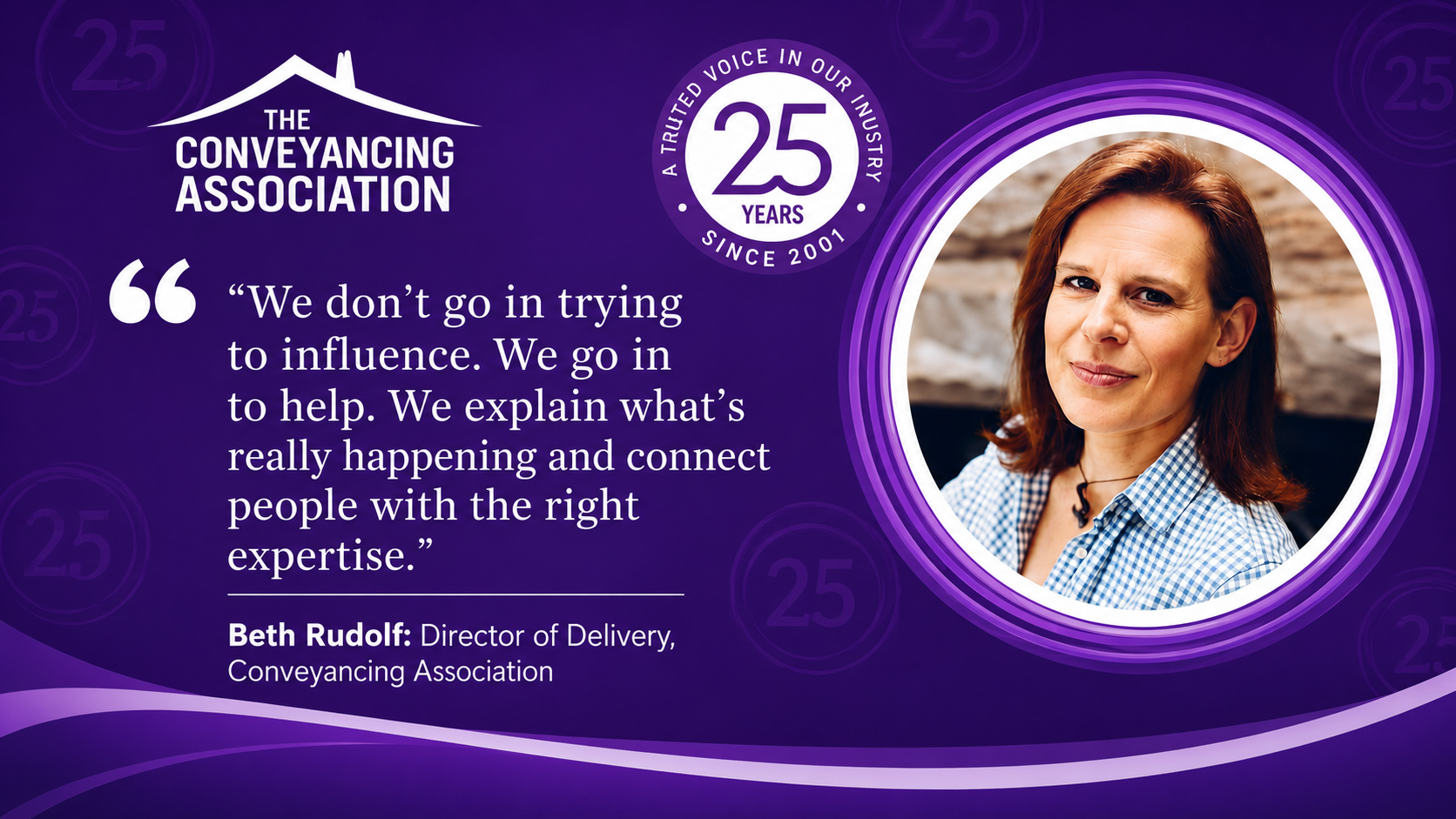
“We don’t go in trying to influence,” she says. “We go in to help. We explain what’s really happening and connect people with the right expertise.”
That approach has helped ensure policy discussions are grounded in the reality of day-to-day conveyancing work. Over the past year, this has included engagement with HMRC and MHCLG on HMRC’s proposed requirement for conveyancers to register as tax advisors in order to submit SDLT returns, while working with the Home Buying & Selling Council to highlight the risk of confusion for consumers and additional burden for firms.
It has also engaged directly with lenders when UK Finance signalled potential charges for access to the Lenders’ Handbook, emphasising the importance of keeping essential information accessible to maintain an efficient process.
The CA’s ability to respond quickly has also been tested in more immediate situations. During Covid, when transactions were at risk of collapsing, the Association focused on identifying what members needed most and working with Government and industry bodies to deliver it. This included developing contract clauses and contributing to the Safe Move Scheme, enabling the home moving sector to reopen in a structured and coordinated way.
Member engagement remains central to this work. Through surveys, working groups and direct conversations, the CA ensures its policy positions are based on real experience. Feedback is gathered consistently, whether through formal consultation responses, targeted outreach to members working in specific areas such as new-build, or roundtables with lenders and other stakeholders.
In some cases, this has led to surprisingly simple but impactful changes.
At one lender roundtable, members highlighted an issue with missing middle names on mortgage documentation requiring a post-offer query and creating delay. The root cause was a system limitation on character length. Once identified and addressed, a source of repeated queries and delay was removed.
This same approach underpins the CA’s wider engagement with stakeholders. Working groups with lenders, discussions with Homes England on Help to Buy equity release, and involvement in updating the New Homes Quality Scheme Code of Conduct have all been informed directly by member input.
This focus on detail is also evident in the CA’s consultation work. Over the past year, the Association has responded to a wide range of policy proposals, including client account interest, the potential removal of conveyancers holding client money, material information guidance and broader home buying and selling reform. In each case, the response has been shaped by the experience and expertise of its membership.
Looking ahead, digitalisation is a key priority. The CA has taken on a leading role within the Digital Property Market Steering Group, acting as Project Lead for the Digital Property Information Protocol. This work is aimed at improving how information is shared across transactions, reducing duplication and offering greater certainty to all parties.
It also links directly to wider efforts to introduce upfront and material information earlier in the process, something the CA has been advocating for a number of years.
Alongside digitalisation, simplification remains a significant challenge. The complexity of leasehold, managed freehold, estate rentcharges and evolving legislation continues to create difficulty for conveyancers and consumers alike.
The Association has been actively engaged in discussions around commonhold as a way of introducing greater consistency and clarity. “Leasehold is like whack-a-mole, every time legislation seeks to fix an issue, another comes up and more change is needed,” says Beth. “Conveyancers have to keep on top of that, but adopting commonhold stops that and creates standardisation enabling the public to understand their home ownership better.”
There is also a growing focus on supporting first-time buyers, including work with the First Time Buyers’ Commission to improve understanding of affordability and access to the property market.
For Beth, while the policy work is central, the value of the Association is also seen in its members and the environment it creates for collaboration.
“The best part is sitting in a room and watching people bounce ideas off each other,” she says. “That’s where real progress happens.”
That collaboration is a defining feature of the CA’s member events. Whether hosted at the Tower of London, the Liver Building or the Churchill War Rooms, these meetings provide an opportunity for conveyancers to step away from day-to-day pressures, share experiences and work through challenges with peers who understand the realities of the role.
Those conversations often feed directly back into the Association’s work. Issues raised inform surveys, shape working groups and ultimately influence the direction of policy engagement, ensuring the CA’s work remains grounded in the practical needs of its members.
That collaborative approach is also supported by the CA’s communication and engagement work. Led by Rob Griffiths Co-Founder of PR Agency, Square 1 Media, the Association’s ability to share insight, publish thought leadership and ensure its work is visible across the sector has played an important role in building credibility with both industry stakeholders and Government.
As the CA reaches this milestone, its impact is clear. From standardising processes and responding to consultations to leading on digital reform, the CA has consistently focused on delivering practical improvements.
The challenges facing the sector continue to evolve, but the approach remains the same. Identify the issue, understand the root cause and work collaboratively to deliver change that benefits both conveyancers and the consumers they serve.
“If members tell us something needs to change,” Beth says, “we’ll dig into it and find a way to make it better.”
Twenty five years on, that focus on practical, informed progress remains at the heart of the Association’s work.
Related Posts